
-
Send an Email
communications@pseta.org.za
-
Helpline and Support
012 423 5700
PSETA is currently not funding the Artisan Development.
A bursary is a formal programme which offers financial assistance to qualifying students for their academic studies. It is awarded based on financial neediness and/or academic performance of a learner (employed or unemployed learners). Employers/Institutions apply for bursary funding to the SETA on behalf of the learners and/or employees who need funding.
Progression from Bursary to Internship
Learners who have completed a bursary programme may be considered for placement in an Internship Programme, subject to the following conditions:
An internship is a workplace-based learning for the purpose of allowing a person who has completed a post-school qualification to gain workplace experience or exposure to enhance competence and/or employability.
Benefits of the Internships?
A Learnership is a workplace-based learning culminating in an occupation qualification or part qualification that is linked to a qualification registered on the National Qualifications Framework (NQF) with the South African Qualifications Authority (SAQA). Learnerships are occupationally directed programmes that include structured theoretical learning and practical workplace component.
What are the benefits of learnerships?
For the learner:
For the Employer:
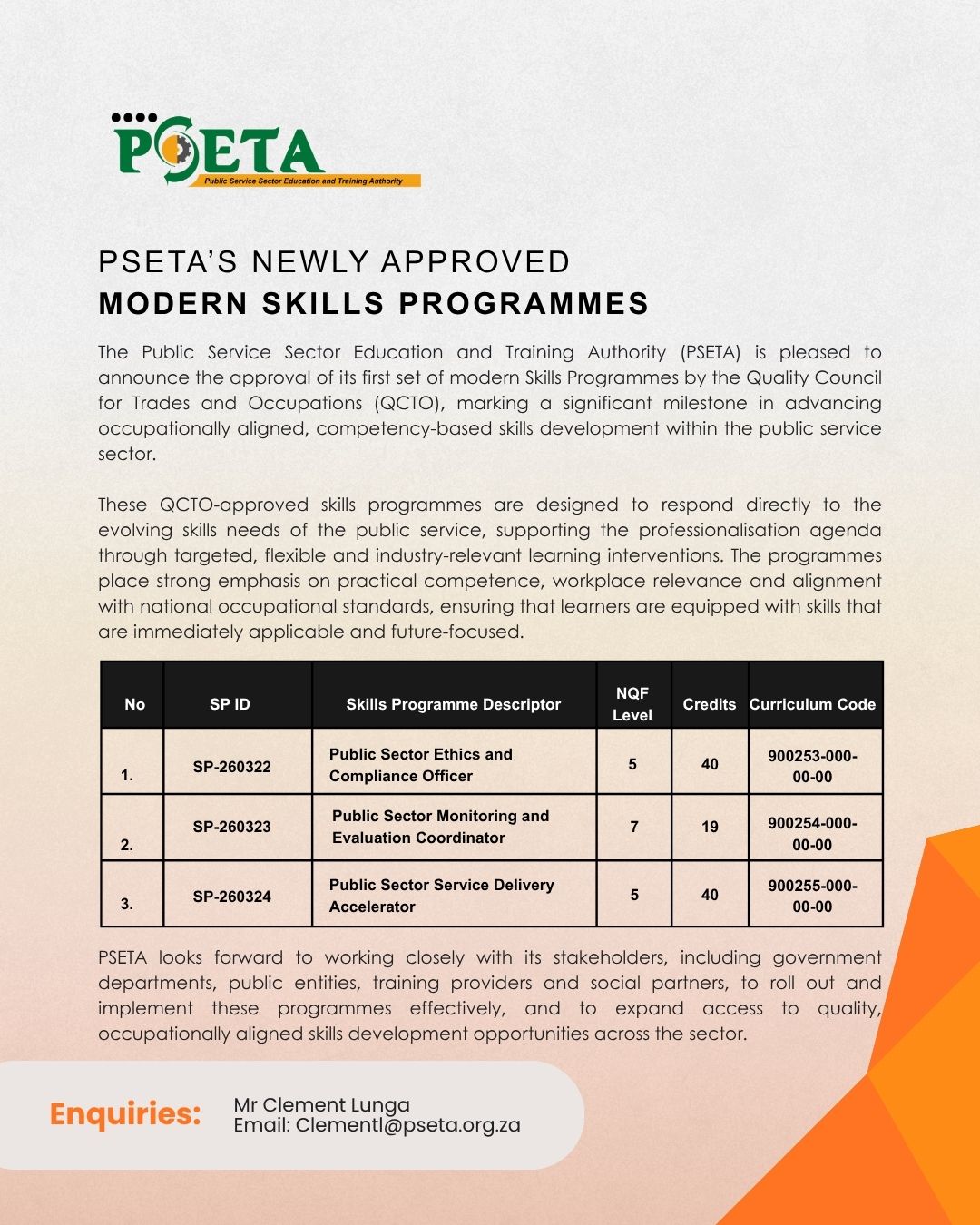
A Skills Programme is a learning programme that is occupationally based and when completed constitutes a credit(s) towards a registered qualification in terms of the NQF Act. The skills programmes are often implemented to meet the needs of the employer to enhance employees’ knowledge for a particular skill.
When completed, will constitute a credit(s) towards a qualification registered in terms of the National Qualifications Framework (NQF) as defined in section 1 of the South African Qualifications Authority (SAQA) Act. Training is offered by an accredited skills development provider.
RPL is an assessment process that involves the assessment of an individual’s relevant prior learning, including formal, informal, and non-formal learning, to determine the credit outcomes of an individual’s application for credits. Individual is assessed, learning is recognised by awarding credits should they meet the requirements of the NQF Registered Qualifications or Part Qualifications.
RPL is an alternative route into a programme of learning/qualification for those who do not meet formal minimum requirements for admission to enrol for a registered qualification.
WIL is a workplace-based learning undertaken as part of the requirement for the National Diploma. Further, it refers to the position of a student or trainee who works in an organisation to gain work experience or satisfy requirements for a qualification.


Woodpecker Building
Hillcrest Office Park177 Dyer Road
177 Dyer Road
Hillcrest
Pretoria
0083
©2024 PSETA All Rights Reserved